|




|

|
We are part of the West Penn Allegheny Health System
|
|

|
Facilities and Resources
The Center for Genomic Sciences (CGS) is a research center within Allegheny-Singer Research Institute. CGS has over 15,000 sq. ft (1500 sq. meters) of laboratory space within the Allegheny-Singer Research Institute (ASRI). These labs are located in recently renovated space on the 9th, 10th and 11th floors of the South Tower of Allegheny General Hospital, the teaching hospital associated with ASRI in Pittsburgh. The administrative and executive offices of CGS, in which the PI and Co-PI have their offices, have recently been relocated to a suite of newly renovated offices on the 11th floor. This suite also contains a library/conference unit which can configured as one large room or two smaller rooms depending on need for meetings and research.
The CGS is a state-of-the-art facility for gene discovery, molecular microbiology, functional genomics, PCR, comparative expressomics, molecular diagnostics and confocal imaging. The facility has laboratories specifically designed for PCR setup and amplification, automated sequencing and fragment analysis, genetic linkage analysis, protein purification, biochemistry, differential display, RNA and DNA array technology, cloning and gene expression, tissue culture, planktonic bacterial growth, and bacterial biofilm growth. An electronic data network digitally links all personnel, laboratories, and data collection systems.
One of the most important renovation items involved re-engineering the heating, ventilation, and air conditioning (HVAC) of wings on the 10th and 11th floors that permit controlled air flow in all of the laboratories. All of the pre-PCR laboratories have positive pressure, and are physically removed from the post-PCR labs which have negative pressure with respect to the hallways. This HVAC system was designed to reduce to an absolute minimum the incidence of false positive results caused by molecular carryover from aerosolized PCR-amplified DNA.
Each laboratory in the CGS is used for a particular purpose with respect to the overall goal of obtaining high-quality, accurate scientific results. Special attention has been paid to the needs of PCR and other molecular biological work requiring template amplification. Samples move through the system in an orderly, unidirectional way, and individual investigators must adhere to this policy. Certain procedures are done in each laboratory and the sample is then transferred to the next.
Each laboratory is completely equipped and self-contained. There is no trafficking of supplies, reagents, or equipment between labs. This is particularly true for pipetting devices, which, if used indiscriminately, are a likely source of contamination. All items are clearly marked as to which laboratory they belong in and all workers are instructed to vigilantly check and adhere to this policy.
Main laboratories
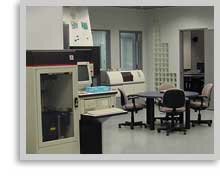
Imaging Facility. The new confocal imaging facility at the Center for Genomics Sciences (CGS) is dedicated primarily to the study of bacterial biofilms and human disease. The facility combines confocal scanning laser microscopy and real-time time lapse imaging of bacterial biofilms growing in situ without having to fix or dehydrate the sample significantly reducing artifacts. The new CGS Imaging Facility will improve our ability to investigate dynamic, living biofilms in situ in three dimensions and in real time.
Specimen processing laboratory. This laboratory serves as the sample collection, logging-in, processing and aliquotting facility. It contains the tissue culture facilities which include three laminar flow hoods, three sets of humidified CO2 incubators, a refrigerated clinical centrifuge, a microfuge, and a kitchen area supplied with all necessary equipment for reagent preparation. Aliquots from each specimen (except one used for the initial assessment) are stored in this room at -80°C. This is a "clean room"; no plasmid or amplified DNA of any kind is allowed in it under any circumstances. No one who has handled amplified DNA without having showered, shampooed, and changed clothing is allowed in this laboratory at any time.
PCR setup laboratories. Two additional laboratories are used for DNA/RNA extractions and PCR setups; one is for infections disease work and the other for human genomics projects. In some cases individual aliquots prepared in the tissue culture room may be brought into these labs, particularly when lysis is being performed on one of the robotic workstations. These are also considered "clean" laboratories and no amplified DNA is ever allowed in them. In some cases the DNA preps are stored here; in other instances they are used immediately to set up PCR reactions. Any individual who has handled amplified DNA must shower and shampoo before entering this lab. These labs contain: Hybaid thermal cyclers for RT reactions, pipetmen, multichannel pipettors, electronic pipettors, electronic multichannel pipettors, pipette aids, Sorvall refrigerated clinical centrifuges; a Jouan refrigerated microfuge, 3 personal minimicrofuges, a Savant speedvac; a Beckman UV-vis spectrophotometer; a Perkin Elmer LS 50 spectrofluorimeter, a two bay sliding glass door refrigerator which houses the CGS working stock DNAs, three -20° C and a -80° C freezer.
PCR amplification laboratory. This lab houses six Perkin-Elmer 9600 thermal cyclers and a MJ research tetrad thermal cycler the latter outfitted with both 96 and 384 well heads; it is considered a "dirty lab" and individuals cannot go from this lab to the pre-PCR labs without showering and shampooing. This lab is also approved for radioactive use and is equipped with GM counters and a Bioscan instrument (radioactive labeling work is done under the authority of the ASRI radiation safety committee, which inspects the laboratory weekly). Most of the amplifications associated with the infectious disease work and genotyping are performed in this laboratory. All of the ID PCR analyses (by liquid hybridization) are also performed in this laboratory on vertical electrophoresis gel rigs specifically designed by Dr. Ehrlich for this purpose. In addition, this lab is used for storage of amplified DNAs that are performed in this room. It contains: a two-bay sliding glass door refrigerator, a -20° C freezer, eight power supplies, and myriad electrophoresis rigs. This lab also has its own kitchen area for gels and buffers as well as tabletop centrifuges and microcentrifuges, and water baths. Nothing ever goes from this room into any clean lab. Any items for further analysis in the darkroom or the gene mapping and sequencing facilities are thoroughly wrapped prior to leaving the lab. Any items to be disposed of are bagged and immediately removed, and are not allowed to sit in the hallways outside other labs.
Cloning, gene expression and biochemistry facility. This facility includes several labs and all of the equipment and reagents for bacterial, yeast, plasmid and phage growth; library construction and subcloning; and colony screening and hybridizations. This facility also contains the systems for production and characterization of recombinantly expressed proteins from bacteria and yeast and contains microbial culture equipment, centrifuges, a refrigerator, and a kitchen area for the preparation of media used in this laboratory and the cloning laboratory. Major equipment includes 2 two-bay refrigerators; a refrigerated microcentrifuge; a tabletop centrifuge; -20°C freezer; high speed centrifuge; New Brunswick shaking incubator; two 37°C plate incubators; a CO2 incubator for pathogenic bacteria; electrophoresis rigs and power supplies; as well as a selection of single and multi-well, manual and electronic pipetting devices. This lab also houses the Perkin-Elmer UV-Visible spectrophotometer and a new Perkin Elmer LS-50B spectrofluorimeter, column chromatography equipment, a Waters HPLC system with an auto-sampler, and refrigerated and heated water baths. All non-coldroom-based biochemistry is performed in this laboratory, including protein purification, fraction analyses, enzyme kinetics, and enzyme activation and degradation studies.
|
|
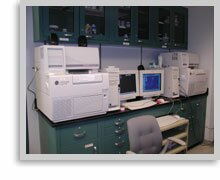
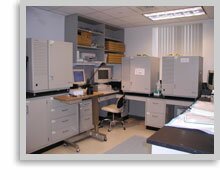
Fluorescent fragment analysis laboratories. These three laboratories (one each on the 9th, 10th, and 11th floors) collectively house over $1 million worth of state-of-the-art automated genomic and expressomic analytical equipment including: 1) two new Beckman capillary electrophoresis automated DNA fragment analyzers; 2) three Applied Biosystems 377 PRISM automated DNA sequencers with fragment analysis software and hardware packages, each with its own Macintosh computer, upgrades for Genescan genotype sequencing, and the running of variable-size gels; 3) three LiCor automated fragment analysis instruments for DNA sequencing and mapping with two computer/software systems; 4) the Genomyx (Beckman) automated fluorescent differential display system which includes an automated electrophoresis/gel drying system, multiple sequencing gel pouring system, a gel band excision system and the automated cooled CCD camera-based fluorescent reader; 3 Sorvall refrigerated clinical centrifuge; a Jouan refrigerated microfuge, a personal minimicrofuge, a Savant speedvac; 5 two-bay sliding glass door refrigerators, a -20° C; and a full complement of pipettes and minor lab equipment.
|
|
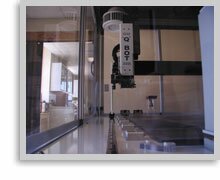
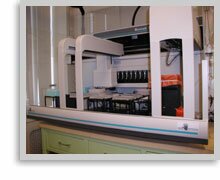
Gene Array Facility: This facility is composed of 4 labs and is equipped with a Genetix Q bot (see figure) which is the only robot that can: 1) pick colonies (w/ color selection) and plaques, 2) grid DNA or bacteria onto filters, 3) grid DNAs onto glass slides to make microarrays, 4) open and close microtiter trays, and 5) re-grid cultures and automatically re-array after normalization. This facility also houses: 1) a new state-of-the-art Beckman FX 2-arm liquid handling robot with crossover capability for massively parallel: plasmid preps for microarrays; PCR clean up; DNA sequencing rxn set up and clean up; and genotyping set up. The FX is currently being equipped with: 1) an integral 96-well Tecan fiber-optic spectrofluorimeter for DNA quantitation which will be integrated with the CGS laboratory relational database GENOMICS; and 2) a high speed microplate centrifuge. This facility is also equipped with a Packard (GSI Lumonics) ScanArray 4000XL for multicolor (up to 5 lasers- currently configured with 3 lasers) analysis of microarrays; and 3) a Cephied real time quantitative thermal cycler - a Smart Cycler for verification of differential gene expression. The Cephied thermal cycler has individual control for every PCR chamber. Additional equipment includes ultra centrifuges, superspeed centrifuges, vacuum centrifuges, microcentrifuges, controlled temperature rotary hybridization ovens, roller bottle incubators, UV-Vis spectrophotometers, bacterial growth chambers and a fume hood.
Protein Biochemistry laboratory. This lab houses 2 HPLC systems and an FPLC unit; a Perkin Elmer LS-50 (research grade) spectrofluorimeter; protein electrophoresis equipment, a UV-Vis spectrophotometer, centrifuges and other assorted minor equipment.
Biofilm laboratory. This lab is equipped with a custom-designed chemostat with peristaltic pumps built by Virtis for biofilm growth, and it is also equipped to do fluorescence microscopy for biofilm analysis. It contains an Olympus computer-controlled robotic micromanipulator which has been mounted on an inverted fluorescence microscope equipped with a digital imaging system. This setup, placed on a vibration isolation table, permits the precise identification and manipulation of biofilms of any type for which a marker has been defined. In addition this lab has a Jouan high-capacity clinical centrifuge; a Dupont-Sorvall Microspin centrifuge; a Coulter counter for determining cell number; a Fisher Isotemp water bath; an Olympus OK2 inverted phase contrast microscope; and all necessary pipetting devices including pipette aids, pipetmen, repeater pipettors, etc.
Support laboratories and facilities
Specimen storage facility. This room contains four -80°C freezers; a -135°C mechanical freezer; and two liquid nitrogen storage systems. All of these units are alarmed and wired to a 24-hour-a-day monitoring service. One of the -80°C freezers serves as a backup in the event of failure of one of the others. All specimens are inventoried and their freezer, rack, and box location are recorded in the CGS central database, GENOMICS, which was designed by the PI and has been operational for almost a decade.
Core centrifuge room. This room houses a Sorvall superspeed and ultra centrifuges and an automated LSC. These instruments are available to all CGS staff on an as-needed basis. Appropriate tubes, fillers, and sealers are located in this room as well.
Cold rooms. Each of the three laboratory floors have a 200-sq-ft 4° C room with an integral -20° C room for large-scale frozen storage located adjacent to the main labs. These facility house rotors, chromatography columns, enzymes, media, etc.
Image analysis facility and darkroom. This laboratory houses a Kodak digital image capture and analysis system which is networked for transfer of all documentation types. The most recent additions to the imaging capabilities of CGS are a Molecular Dynamics Phosphor Imaging system which is connected via Ethernet to the laboratory database and the sequencing and mapping laboratory. The photographic darkroom has been set up for developing autoradiographic exposures of gel and filter hybridizations. A Kodak automatic X-ray film developer and processor has been purchased and a darkroom lighting system with outside warning light has been installed. This system will greatly reduce exposure times, allowing more rapid reporting of clinical results. A Polaroid MP4 camera system with UV trans-illuminator and wall-mount white-light illuminators is also available. A portable Fotodyne Trans-illuminator and Polaroid camera with various isolation hoods is also available for bench-top photography of ethidium bromide-stained gels.
Data analysis facility. This office houses the data storage and analysis center, which contains a high-end LINUX server with mirrored backup of all critical systems throughout CGS. All users of the CGS can access and input data through Windows NT/NOVEL client software. The server contains the Progeny and BLAST commercial databases, as well as CGS's own Sybase and Rbase databases, GENOMICS, designed by Dr. Ehrlich, which currently holds records on over 30,000 specimens. Numerous software packages for data manipulation are available locally and through Internet hookups. Planned expansions include a Windows USER server which will serve as front end for the LINUX server and provide an added level of security as we bring online a web-based version of GENOMICS.
Animal facilities. The fully functional 10,000-sq-ft Allegheny-Singer Research Institute animal facility (located in the same building) houses both small and large animals and has facilities for animal experiments and surgery. Around-the-clock husbandry and veterinary care is available for all projects. The facility is fully approved under IACUC protocols.
Other resources
Offices and personal computers. The CGS is also equipped with office space, computers, storage and file areas (including secure files for confidential records), a conference room, a photocopier, and secretarial support. Each staff member in the CGS has a computer. Individual computer workstations are mostly high-end Pentium PCs running Windows NT 4.0/2000 professional, plus a few Power Macs, with a full complement of standard software (word processing, spreadsheets, database software, pedigree-drawing programs, graphics packages, pedcheck programs, linkage programs, e-mail, Netscape, etc.). All of the workstations are networked by LAN and connected with the Internet. Several laser printers (black-and-white and color) and several inkjet printers are placed throughout the center.
|